Patient Access API (Interop)
TPAStream supports carrier Patient Access APIs for SDK users. Instead of collecting carrier credentials inline, the user authenticates on the carrier's own website and TPAStream receives a 90-day access token that it uses to harvest the data. The init option that enables this flow is enablePatientAccessAPI.
Renamed in 0.8. The option was originally called
enableInterop; both names still work indefinitely. PassingenableInteroplogs a one-time console deprecation warning but otherwise behaves identically. New integrations should use the canonical name.
Client Usage
When enablePatientAccessAPI is set and your tenant / token is configured within TPAStream as Patient Access API-compliant, the SDK exposes payers that authenticate via a redirect to the payer website instead of an inline credentials form.
Here's how the flow goes at a top level:
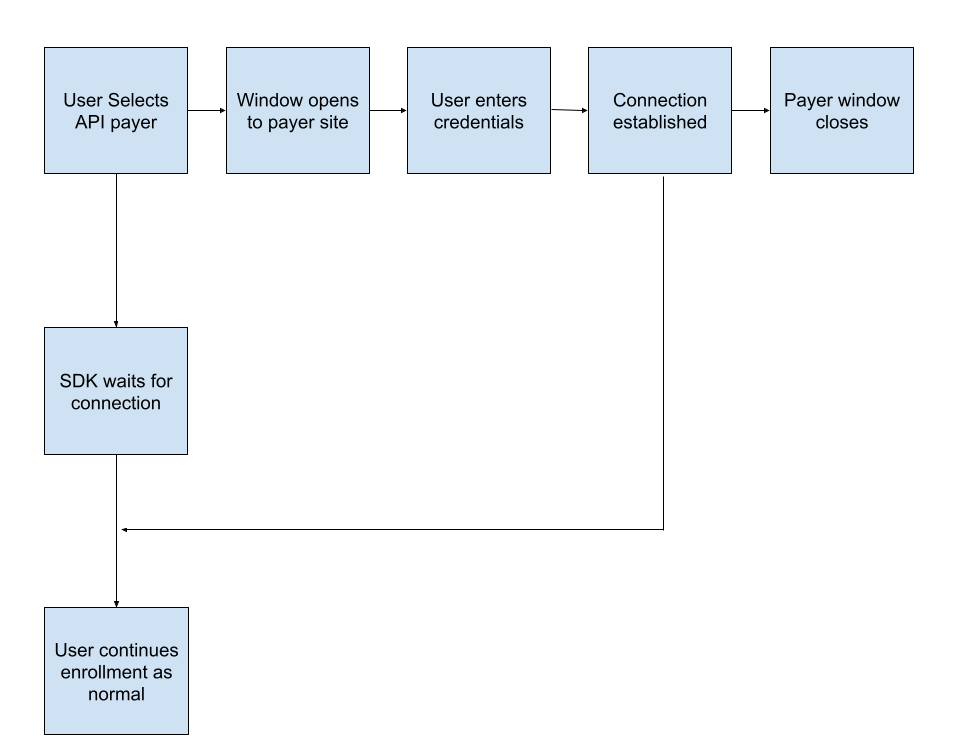
As shown above, the user is sent to a new window on the payer's website, completes authentication there, and the SDK detects the connection back to TPAStream and continues normally.
Single-page variant
Pass enablePatientAccessAPISinglePage instead of (or in addition to) enablePatientAccessAPI to perform the redirect in the current tab rather than opening a new window. When both are set, single-page wins.
The legacy alias enableInteropSinglePage is also still accepted with the same deprecation-warning treatment.
Redirect query parameters
After the carrier redirect completes, the SDK reads two URL parameters automatically on load:
?accessToken=...: a fresh connect-access token minted byapp.tpastream.com.?forceTPAStreamSdkEnd=1: set in the single-page variant to flag the OAuth return. As of 0.8.2 the SDK shows a self-dismissing "Connected" toast in the floating panel and returns the member to the carrier picker (so they can add another carrier) rather than the full-page end widget. WhenrealTimeVerification: false(no panel), it falls back to the end widget. The explicitforceEndStepinit option is unaffected and still routes to the end widget.
Both are stripped from the URL via history.replaceState so they cannot leak via browser history or autofill. See Client Usage > Redirect query parameters for the full mechanics.
See also
- Connect Access Token: how the
?accessToken=minting fits into the broader connect-token security model - Fix Credentials: Patient Access API carriers show up in the same fix-credentials list with the same status badges as inline-credential carriers